RESEARCH
·
Soaring Tensions
Tensions are soaring in the Middle East. Learn what the market is watching and how these events shape your money in this week's edition of Tired & Rich.

Tom Stadum
5 min read
From Fjell Insights.
Fjell Capital
Category
tmrw
Share
Soaring Tensions
The last 72 hours have changed things a bit.
As probably billions of people have seen, the tensions in the Middle East have soared.
I wasn’t planning on discussing this with you today as I have a piece finished on the US financial system (that’ll be for next week), but the events this week have our phones ringing, and I want to give you some context and market history as this pertains to your investments.
The Middle East is the birthplace of civilization.
Many of us, through faith or family, are uniquely tied to the relatively small geographic area.
It’s a strange phenomenon.
I don’t typically get calls about tensions in Europe, Africa, South America, or Southeast Asia, but the Middle East is different.
The past few weeks, particularly the last 72 hours, have been heavy.
I certainly am not an expert in the nuances of Middle Eastern politics and am not going to pretend I am, but I have been a wealth manager for over a decade and have had many phone calls with clients about their money and these events.

This Impacts Your Money… Sort of
Wars, instability, and tension must be bad for markets, right?
Sort of.
I was in a meeting with a client when the salvo of missiles flew into Israel’s airspace on Tuesday.
I knew heading into the meeting that tensions were high, but as I was walking back to my office, bright red headlines from CNBC greeted me, saying an attack was imminent.
That sinking feeling hit my stomach, and I went to X (formerly Twitter) to find out what was happening in real-time.
Israelis were already posting videos of the missiles getting knocked out by the Iron Dome.
After I processed the news as a human, husband, and dad, my brain went to our clients and the markets.
This stuff shakes people’s confidence in their portfolios, particularly those who are nearing or in retirement.
But here’s the deal: Markets always know that something is going to happen in the Middle East.
It’s not if some shock to the system happens; it’s when it happens.
One hundred years of market history can be overlayed with every single wartime conflict.
Check out this chart from our friends at First Trust:
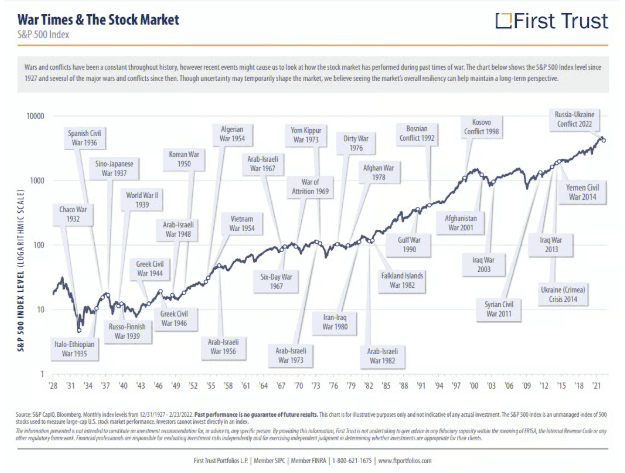
The market perpetually prices these shocks.
And your portfolio, whether you know it or not, also does.
To What Extent (Is The Key)
I remember writing to our clients after Russia invaded Ukraine in February 2022 as I was on a family vacation in Red Lodge, MT (duty calls).
I referenced a Goldman Sachs research note where the authors figured the conflict was close to being priced within weeks of the event.
This means that, at the time, we were around 5-7% from the lows based on the variables Goldman was measuring.
Many other large geopolitical shocks happened that year- China shutting down, the Suez Canal blockage, and the subsequent supply chain drama that drove inflation higher, which pushed the market lower for the year, but the conflict was priced into the US markets relatively quickly after it figured out the extent of market damage.
This is not the extent of human, societal, or economic damage but instead market damage.
The markets always look for the extent of the damage, not the damage that was done.
This idea of “to what extent” is highly nuanced and has profound implications for your portfolio.
The extent is what we are looking at as we invest portfolios.
So here is what took place on Tuesday:
Oil was up big (pretty obvious), bonds were up (pretty obvious), and some took profits in the equity markets.
From here, it’s all about where the conflict goes and the extent of its impact on US asset prices.
While Middle East tensions are dominating headlines right now, China’s new stimulus bill was another massive news story that broke last week.
I won’t bore you with details, but China is unleashing the money cannon to heat up its economy.
“Cool, Tom, what does that mean for me?”
If you remember my piece on liquidity a few months ago (find it here), this is precisely what will happen in China.
The second-largest economy in the world is about to pump up its economy with cash.
When the second largest economy in the world does something big, it’s worth tuning in for.
Smart money is talking about this and figuring out the impact of this on investments.
It’s hard to know how the spillover affects the US, but let’s just say that Chinese stocks have had a pretty good last two weeks.
This happened just one week after the largest economy in the world, the US, started cutting interest rates.
Liquidity is coming back after two years without it.
So Now What?
Fear moves people and money in ways that good doesn’t.
The news about China’s stimulus package probably didn’t make it into your social media feeds, even though it will most likely help your portfolio.
The events in Israel have moved us as people, but the portfolio impact will most likely be negligible as the conflict stands today.
And the Fed is still cutting rates.
There’s still a ton of cash on the sidelines waiting to be deployed.
People are moving away from C.D.s and money market funds.
There are opportunities out there for intelligent investors.
To leave you with this, here is the market’s performance since April, the last time Iranians sent a salvo of missiles at Israel: 12.57%.
Here’s the market’s performance since Russia invaded Ukraine: 27.5%.
As I said, human suffering is great in these events. I will not sugarcoat anything; you can’t unsee what we saw on Tuesday.
But your portfolio and the markets are already looking ahead at the backstop of new liquidity coming into the two biggest economies on earth.
Oh, and remember A.I., yeah, that’s still happening too.
Keep playing the long game.
See you around.
Tom Stadum
Sources & method
Originally published in Fjell Insights.
Written by
Tom Stadum
Founder, Wealth Advisor
Tom is the third generation of the practice that started in 1961. He spent seven years at UBS Financial Services as a Senior Vice President in wealth management before co-founding Fjell Capital in August 2020. He chairs the firm’s investment committee and works directly with client families.
Contact
KEEP READING
More from the archive
Stocks One Year After the Fed Started Hiking
The S&P 500 was higher one year after six of seven completed Fed tightening cycles since 1983. The median gain was 4.4%.
READ
The Treasury Tripled the Size of Its Buybacks
The federal government owes just over $40 trillion, and Treasury has tripled the size of a long-end bond buyback operation as borrowing costs rise.
READ
Apple Added $4.3 Trillion Under Tim Cook
Apple was worth $349 billion when Tim Cook became CEO and $4.66 trillion when he stepped down fifteen years later.
READ
tmrw, delivered straight to your inbox.
One letter a week, and the charts on Tuesdays. No sales material, and no list sharing. Unsubscribe in one click.
Like what you are reading?
Let’s talk about it.
If something we published applies to your own situation, that is the right reason to call.
See if you are a fit
Educational content only. Nothing published here is personalized investment, legal or tax advice, a recommendation of any security, or an offer to buy or sell. Views are as of the date of publication and are not updated. Past performance does not guarantee future results.