RESEARCH
·
Don’t Mistake Brains for a Bull Market
Strong market returns can mask bad financial decisions and risky behavior. This edition of tmrw explains how long-term wealth is built through disciplined investing, sound behavior, and planning for life’s inevitable events. A perspective for investors focused on protecting and stewarding their wealth, not just growing it.

Tom Stadum
7 min read

From Fjell Insights.
Fjell Capital
Category
tmrw
Share
“Don’t mistake brains for a bull market.”
In 2013, freshly out of business school, I started working as an associate with my dad.
If you happen to recall, 2013 was an extremely good year in the equity markets. The S&P 500 closed out the year up 29.6%.
Sometime during that year, my dad came into my office and told me “Tom, don’t mistake brains for a bull market”. It was a strange thing to learn in what would become one of the best markets of an entire generation.
Everything is easy when the markets go up big. What he was really teaching though, as a young man brimming with optimism, was this:
The euphoric mountain top experience of 2013 was just that, a mountain top. Life isn’t a continuous mountain top experience. Cancer diagnosis’s, college educations to fund, unforeseen home maintenance, business’s to scale and sell, let’s not forget this isn’t the end of the story.
Every financial outcome comes from three inputs:
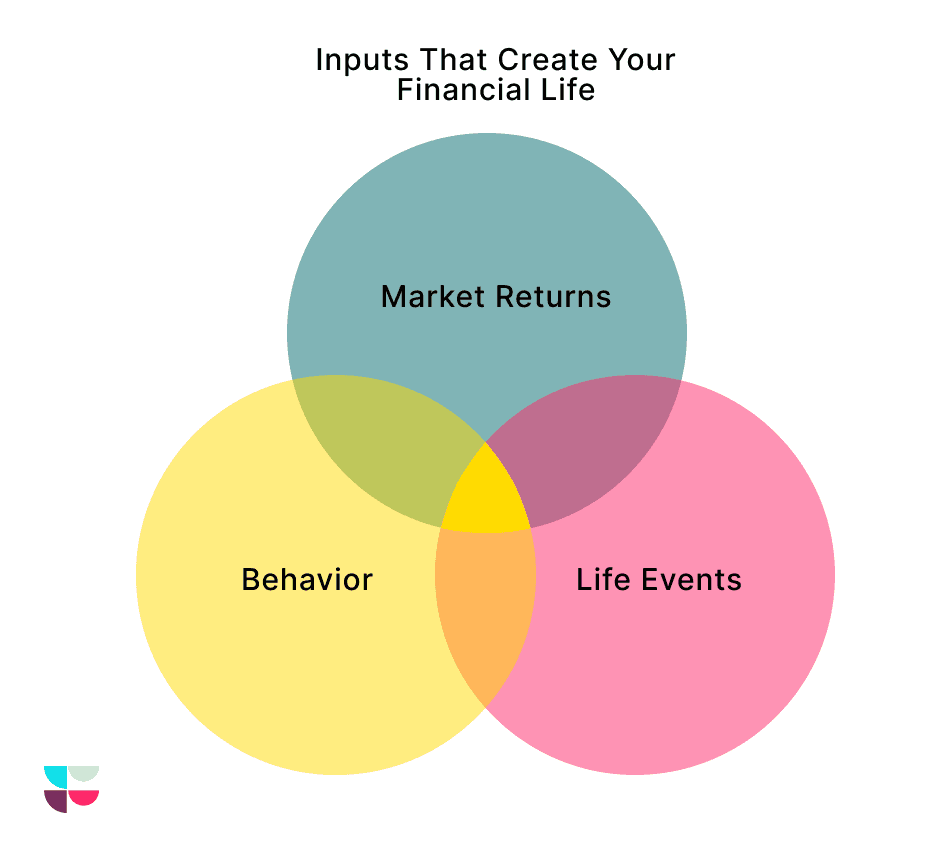
Here is simple run down:
Market Returns
Post 50s, the engine of your financial life transitions to your assets, not your income. The markets, and the assets you choose, become a form of an employer, they pay you, they grow to give you more, or pull you back in hard times. The paradox is you are the owner, and the employee.
Behavior
Here’s what I know to be universally true about money, you are wired to be either a spender, saver, hoarder, etc. I am a spender by nature. I don’t fight it, I manage around it. I focus on areas where I am good at to counterbalance how my personality type interfaces with money. More money doesn’t fix bad behavior, it amplifies it, the opposite is true as well.
Life Events
Life is planned in our minds yet reality reveals randomness everywhere. There’s a season of life to have children, there’s a season to retire, there’s cancer diagnosis, business sales, and everything in between. Each affects your financial life in ways that is impossible to predict. We think we know what the future holds, we in reality, we don’t.
We’re crossing the finish line that is 2025 with another solid year in the equity markets.
The market has likely done the heavy lifting for you, which is why we invest in the first place, but examining behavior now is the question I am asking myself.

Your net worth is a collection of decisions you’ve made that total up to how much money you have today.
Every investment was preceded by a decision.
Every decision to spend, was preceded by a choice in your mind.
Every life event, good or bad, was accompanied by a reaction and a set of choices.
The sum of these actions and decisions is your net worth.
Think of it like this:
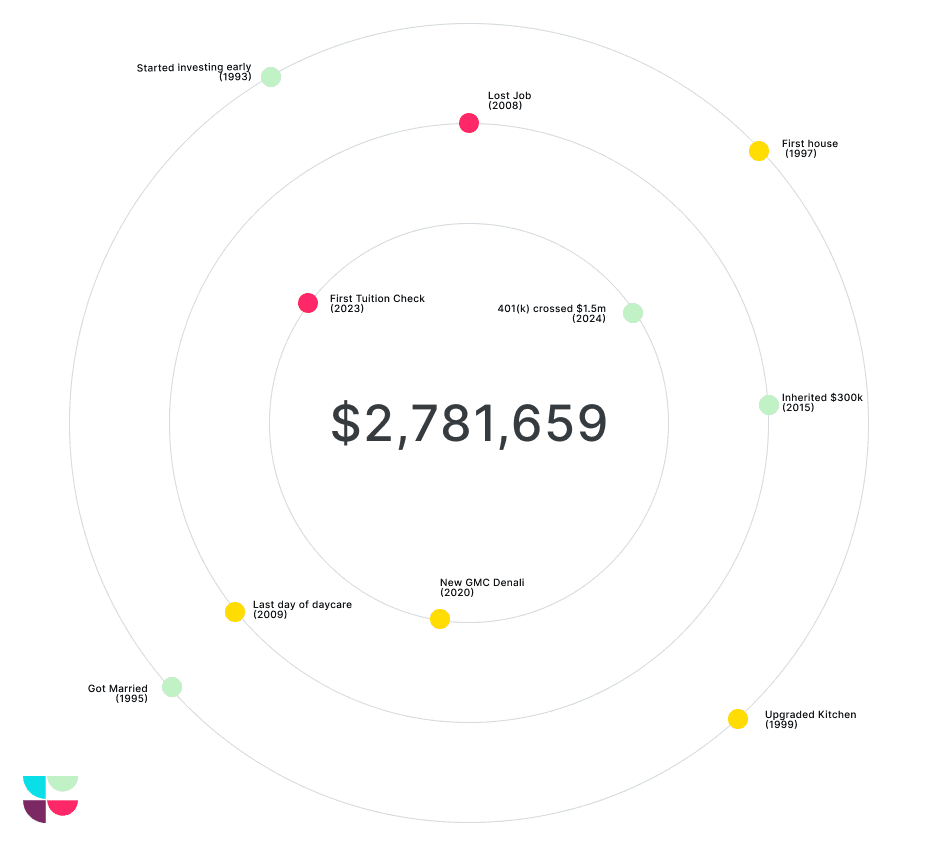
If this is true, Warren Buffet’s quote must also be true:
“The most important investment you can make is in yourself.”
Translation for this edition: you matter immensely in your own financial life, in bear market, bull markets, good times and not. And the research could not be clearer, we’re often our own worst enemies.
We’re practically hardwired to make the wrong decisions at the wrong time.
Takes these three studies as an example:
Vanguard’s Advisor’s Alpha research suggests that disciplined investor behavior alone, staying disciplined, rebalancing, and avoiding emotional decisions, can be worth around 1-1.5% per year to long-term returns.
Behavioral research from Kahneman and Tversky finds that people tend to feel losses roughly twice as strongly as gains, which is why fear-driven decisions tend to show up long after good markets have passed.
Research from the National Bureau of Economic Research finds that households who regularly plan and review their financial decisions accumulate meaningfully more wealth over time, regardless of income.
Strong markets are great, the heal our finances, but they also can make it easy to forget recent pain. Like 2022, when we experience almost 10% inflation, and the worst bond market since the 1850s. It already feels like a distant memory, but that was just three years ago.
Times are good in 2025, the Mag 7 is still spending billions on the AI build out, it’s easy to forget about important questions, like:
Is my will up to date?
Is my tax strategy in up markets, protecting myself from down markets?
Have I looked into my allocation recently?
Have I given enough to causes I care about?
I am paying too much in Medicare?
Those questions don’t get you to the top of the mountain, they keep you safe on the way down.
And when the good times end, like they did as we closed out 2021 and started 2022, or when life happens (you need to help an adult child handle a layoff), your choices become your net worth in the years to come.
If this is true, Warren Buffet’s quote must also be true:
“The most important investment you can make is in yourself.”
Translation for this edition: you matter immensely in your own financial life, in bear market, bull markets, good times and not. And the research could not be clearer, we’re often our own worst enemies.
We’re practically hardwired to make the wrong decisions at the wrong time.
Takes these three studies as an example:
Vanguard’s Advisor’s Alpha research suggests that disciplined investor behavior alone, staying disciplined, rebalancing, and avoiding emotional decisions, can be worth around 1-1.5% per year to long-term returns.
Behavioral research from Kahneman and Tversky finds that people tend to feel losses roughly twice as strongly as gains, which is why fear-driven decisions tend to show up long after good markets have passed.
Research from the National Bureau of Economic Research finds that households who regularly plan and review their financial decisions accumulate meaningfully more wealth over time, regardless of income.
Strong markets are great, the heal our finances, but they also can make it easy to forget recent pain. Like 2022, when we experience almost 10% inflation, and the worst bond market since the 1850s. It already feels like a distant memory, but that was just three years ago.
Times are good in 2025, the Mag 7 is still spending billions on the AI build out, it’s easy to forget about important questions, like:
Is my will up to date?
Is my tax strategy in up markets, protecting myself from down markets?
Have I looked into my allocation recently?
Have I given enough to causes I care about?
I am paying too much in Medicare?
Those questions don’t get you to the top of the mountain, they keep you safe on the way down.
And when the good times end, like they did as we closed out 2021 and started 2022, or when life happens (you need to help an adult child handle a layoff), your choices become your net worth in the years to come.
“You don’t pay me to get to the top. You pay me to get you down.”
This is one of my all time favorite quotes, it’s a common phrase mountaineering guides use with their clients to share the ultimate objective: don’t die up there.
In business and life, it reminds me that hardship and pain often times come after moments of triumph.
Having a child is one of life’s miracles, yet the next four months of sleepless nights are the definition of tired.
Promotions are great, until you need to be the one to have the hard conversations of laying off 25 of your employees.
Having a $3.5 million nest is great, but losing $700k in a bear market is hard to stomach.
Your financial life is at a peak, your financial life was meant to peak. Market’s are meant to break all-time highs.
While there’s much effort to get to the top, your main job as your net worth grows is to keep it.
You do that by keeping in check key areas of your life, regardless of season.
Here are some questions I am asking myself, and my wife, this year end as we close out a banner year personally, and professionally:
Are we more free, financially, this year end vs last?
What key decisions did we make this year that propelled us forward?
Did our cashflow system work? If not, what do we need to change for 2026?
What is our biggest opportunity to chase down?
Are we pleased with our we stewarded our finances this year? Why or Why Not?
Remember why you got here and why you need to get down, or keeping climbing:
It’s to bring your future self, and your family, more freedom.
More freedom to take trips, more future income, more gifts to charity, less stress, less anxiety, better sleep, less pressure.
You don’t choose the peaks, this year end may not even be the peak, but your job, and mine, is to ask the hard questions, make the changes, and keep moving.
Thanks for your time this week.
Tom
PS. If you’re considering an advisor change in 2026, I’m here.
Tom Stadum
Sources & method
Originally published in Fjell Insights.
Written by
Tom Stadum
Founder, Wealth Advisor
Tom is the third generation of the practice that started in 1961. He spent seven years at UBS Financial Services as a Senior Vice President in wealth management before co-founding Fjell Capital in August 2020. He chairs the firm’s investment committee and works directly with client families.
Contact
KEEP READING
More from the archive
Apple Added $4.3 Trillion Under Tim Cook
Apple was worth $349 billion when Tim Cook became CEO and $4.66 trillion when he stepped down fifteen years later.
READ
Earnings Grew in Ten of Eleven Sectors
A war in the Gulf and a construction boom produced most of the quarter's profit growth.
READ
The Highest in 19 Years
The Fed has cut six times since 2024. The 30-year Treasury went the other way, to its highest yield in nineteen years.
READ
tmrw, delivered straight to your inbox.
One letter a week, and the charts on Tuesdays. No sales material, and no list sharing. Unsubscribe in one click.
Like what you are reading?
Let’s talk about it.
If something we published applies to your own situation, that is the right reason to call.
See if you are a fit
Educational content only. Nothing published here is personalized investment, legal or tax advice, a recommendation of any security, or an offer to buy or sell. Views are as of the date of publication and are not updated. Past performance does not guarantee future results.